Using AVTranscoder to Transcode Videos (C/C++)
Starting from API version 20, NDK (C/C++) APIs are provided for video transcoding.
You can use the AVTranscoder to implement video transcoding. You can call canIUse to check whether the device supports AVTranscoder and continue the operations described in this topic only when the return value of canIUse("SystemCapability.Multimedia.Media.AVTranscoder") is true.
This topic describes how to use the AVTranscoder to implement video transcoding, covering the process of starting, pausing, resuming, and exiting transcoding.
Figure 1 AVTranscoder state transition
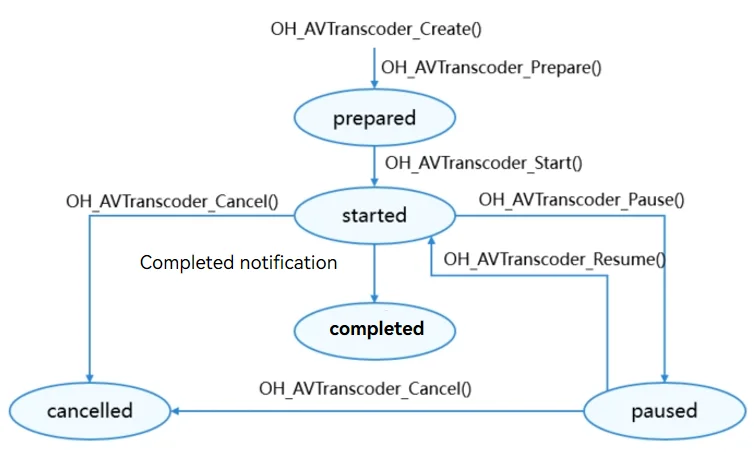
For details about the states, see OH_AVTranscoder_State.
How to Develop
Link the dynamic libraries in the CMake script.
target_link_libraries(entry PUBLIC libavtranscoder.so libace_napi.z.so)
To use system logging, include the following header file:
#include <hilog/log.h>
In addition, link the following dynamic libraries in the CMake script:
target_link_libraries(sample PUBLIC libhilog_ndk.z.so)
Import the avtranscoder.h and avtranscoder_base.h header files to use the transcoding APIs. Read AVTranscoder for the API reference.
-
Call OH_AVTranscoder_Create() to create a transcoding instance.
OH_AVTranscoder *transcoder = OH_AVTranscoder_Create(); -
Set callback functions. Specifically, call OH_AVTranscoder_SetStateCallback(), OH_AVTranscoder_SetErrorCallback(), and OH_AVTranscoder_SetProgressUpdateCallback() to set callbacks for transcoding status changes, transcoding error events, and transcoding progress update events, respectively. The table below describes these callbacks.
| Event Type | Description |
|---|---|
| OH_AVTranscoder_OnStateChange | Optional event, which is invoked when the transcoding status changes. |
| OH_AVTranscoder_OnError | Optional event, which is invoked when a transcoding error occurs. |
| OH_AVTranscoder_OnProgressUpdate | Optional event, which is invoked when the transcoding progress changes. |
You can also customize data using userData in these callbacks.
```c++
typedef struct NdkAVTransCoderUser {
   using StateChangeFunc = std::function<void()>;
   NdkAVTransCoderUser();
   NdkAVTransCoderUser(const NdkAVTransCoderUser &other) = delete;
   NdkAVTransCoderUser &operator=(const NdkAVTransCoderUser &other) = delete;
   ~NdkAVTransCoderUser();

   void OnStateChangeCb(OH_AVTranscoder *transcoder, OH_AVTranscoder_State state);
   void OnErrorCb(OH_AVTranscoder *transcoder, int32_t errorCode, const char  *errorMsg);
   void OnProgressUpdateCb(OH_AVTranscoder *transcoder, int progress);
   std::map<uint32_t, StateChangeFunc> stateChangeFuncs_;

   OH_AVTranscoder *transcoder = nullptr;
   int32_t errorCode = AV_ERR_OK;
   OH_AVTranscoder_State transCoderState = AVTRANSCODER_PREPARED;
   int avTranscoderProgress = 0;
   int inStartStateCount = 0;
} NdkAVTransCoderUser;

void NdkAVTransCoderUser::OnProgressUpdateCb(OH_AVTranscoder *transcoder, int  progress)
{
   LOG("NdkAVTransCoderUser OnProgressUpdateCb progress: %{public}d", progress);
   this->avTranscoderProgress = progress;
}

void NdkAVTransCoderUser::OnErrorCb(OH_AVTranscoder *transcoder, int32_t  errorCode, const char *errorMsg)
{
   LOG("NdkAVTransCoderUser OnErrorCb errorCode: %{public}d ,errorMsg: %{public} s", errorCode,
      errorMsg == nullptr ? "unknown" : errorMsg);
   this->errorCode = errorCode;
}

void NdkAVTransCoderUser::OnStateChangeCb(OH_AVTranscoder *transcoder,  OH_AVTranscoder_State state)
{
   this->transCoderState = state;
   if (transcoder == nullptr) {
      return;
   }
   int32_t ret = -1;
   switch (state) {
      case AVTRANSCODER_PREPARED: {
            this->transCoderState = AVTRANSCODER_PREPARED;
            if (this->stateChangeFuncs_.count(AVTRANSCODER_PREPARED) > 0) {
               this->stateChangeFuncs_[AVTRANSCODER_PREPARED]();
            }
            break;
      }
      case AVTRANSCODER_STARTED: {
            this->transCoderState = AVTRANSCODER_STARTED;
            if (this->stateChangeFuncs_.count(AVTRANSCODER_STARTED) > 0) {
               this->stateChangeFuncs_[AVTRANSCODER_STARTED]();
            }
            break;
      }
      case AVTRANSCODER_PAUSED: {
            this->transCoderState = AVTRANSCODER_PAUSED;
            if (this->stateChangeFuncs_.count(AVTRANSCODER_PAUSED) > 0) {
               this->stateChangeFuncs_[AVTRANSCODER_PAUSED]();
            }
            break;
      }
      case AVTRANSCODER_CANCELLED: {
            this->transCoderState = AVTRANSCODER_CANCELLED;
            if (this->stateChangeFuncs_.count(AVTRANSCODER_CANCELLED) > 0) {
               this->stateChangeFuncs_[AVTRANSCODER_CANCELLED]();
            }
            break;
      }
      case AVTRANSCODER_COMPLETED: {
            this->transCoderState = AVTRANSCODER_COMPLETED;
            if (this->stateChangeFuncs_.count(AVTRANSCODER_COMPLETED) > 0) {
               this->stateChangeFuncs_[AVTRANSCODER_COMPLETED]();
            }
            break;
      }
      default:
            break;
   }
}

static void AvTranscoderStateChangeCbImpl(OH_AVTranscoder *transcoder,  OH_AVTranscoder_State state, void *userData)
{
   LOG("AvTranscoderStateChangeCbImpl state: %{public}d", state);
   NdkAVTransCoderUser *ndkAVTransCoderUser =  reinterpret_cast<NdkAVTransCoderUser *>(userData);
   if (ndkAVTransCoderUser == nullptr||transcoder == nullptr) {
      LOGE("AvTranscoderStateChangeCbImpl ndkAVTransCoderUser or transcoder is  nullptr");
      return;
   }
   ndkAVTransCoderUser->OnStateChangeCb(transcoder, state);
}

static void AvTranscoderErrorCbImpl(OH_AVTranscoder *transcoder, int32_t  errorCode, const char *errorMsg,
                                    void *userData)
{
   LOG("AvTranscoderErrorCbImpl errorCode: %{public}d, errorMsg: %{public}s",  errorCode,
      errorMsg == nullptr ? "unknown" : errorMsg);
   NdkAVTransCoderUser *ndkAVTransCoderUser =  reinterpret_cast<NdkAVTransCoderUser *>(userData);
   if (ndkAVTransCoderUser == nullptr||transcoder == nullptr) {
      LOGE("AvTranscoderErrorCbImpl ndkAVTransCoderUser or transcoder is  nullptr");
      return;
   }
   ndkAVTransCoderUser->OnErrorCb(transcoder, errorCode, errorMsg);
}

static void AvTranscoderProgressUpdateCbImpl(OH_AVTranscoder *transcoder, int  progress, void *userData)
{
   LOG("AvTranscoderProgressUpdateCbImpl progress: %{public}d", progress);
   NdkAVTransCoderUser *ndkAVTransCoderUser =  reinterpret_cast<NdkAVTransCoderUser *>(userData);
   if (ndkAVTransCoderUser == nullptr||transcoder == nullptr) {
      LOGE("AvTranscoderProgressUpdateCbImpl ndkAVTransCoderUser or transcoder is  nullptr");
      return;
   }
   ndkAVTransCoderUser->OnProgressUpdateCb(transcoder, progress);
}
static napi_value OHAvTranscoderNdkPlay(napi_env env, napi_callback_info info)
{
   OH_AVTranscoder_SetStateCallback(transcoder, AvTranscoderStateChangeCbImpl, transcoderUser); // Set the status callback.
   OH_AVTranscoder_SetErrorCallback(transcoder, AvTranscoderErrorCbImpl, transcoderUser); // Set the error callback.
   OH_AVTranscoder_SetProgressUpdateCallback(transcoder, AvTranscoderProgressUpdateCbImpl, transcoderUser); // Set the progress callback.
}
```
-
Call OH_AVTranscoderConfig_Create() to create a transcoding configuration instance.
OH_AVTranscoder_Config *config = OH_AVTranscoderConfig_Create(); -
Call OH_AVTranscoderConfig_SetSrcFD() to set the file descriptor of the source video.
OH_AVTranscoderConfig_SetSrcFD(config, srcFd, srcOffset, length); // Set the file descriptor of the source video. -
Call OH_AVTranscoderConfig_SetDstFD() to set the file descriptor of the output video.
OH_AVTranscoderConfig_SetDstFD(config, dstFd); // Set the file descriptor of the output video. -
(Optional) Call OH_AVTranscoderConfig_SetDstVideoType() to set the encoding format of the output video.
OH_AVTranscoderConfig_SetDstVideoType(config, "video/avc"); // (Optional) Set the video encoding format. -
(Optional) Call OH_AVTranscoderConfig_SetDstAudioType() to set the encoding format of the output audio.
OH_AVTranscoderConfig_SetDstAudioType(config, "audio/mp4a-latm"); // (Optional) Audio encoding format. -
Call OH_AVTranscoderConfig_SetDstFileType() to set the container format of the output video.
OH_AVTranscoderConfig_SetDstFileType(config, AV_OUTPUT_FORMAT_MPEG_4); // Container format. -
(Optional) Call OH_AVTranscoderConfig_SetDstAudioBitrate() to set the bit rate of the output audio.
const std::int32_t AUDIO_BITRATE = 200000; OH_AVTranscoderConfig_SetDstAudioBitrate(config, AUDIO_BITRATE); // (Optional) Audio bit rate. -
(Optional) Call OH_AVTranscoderConfig_SetDstVideoBitrate() to set the bit rate of the output video.
const std::int32_t VIDEO_BITRATE = 3000000;
OH_AVTranscoderConfig_SetDstVideoBitrate(config, VIDEO_BITRATE); // (Optional) Video bit rate.
-
Call OH_AVTranscoder_Prepare() to prepare for transcoding. After a successful call, the instance transitions to the AVTRANSCODER_PREPARED state.
OH_AVErrCode errCode = AV_ERR_OK; errCode = OH_AVTranscoder_Prepare(transcoder, config); // Prepare for transcoding. -
Call OH_AVTranscoder_Start() to start transcoding. After a successful call, the instance transitions to the AVTRANSCODER_STARTED state.
OH_AVErrCode errCode = AV_ERR_OK; errCode = OH_AVTranscoder_Start(transcoder); // Start transcoding. -
(Optional) Call OH_AVTranscoder_Pause() to pause transcoding. After a successful call, the instance transitions to the AVTRANSCODER_PAUSED state.
OH_AVErrCode errCode = AV_ERR_OK; errCode = OH_AVTranscoder_Pause(transcoder); // Pause transcoding. -
(Optional) Call OH_AVTranscoder_Resume() to resume transcoding. After a successful call, the instance transitions to the AVTRANSCODER_STARTED state.
OH_AVErrCode errCode = AV_ERR_OK; errCode = OH_AVTranscoder_Resume(transcoder); // Resume transcoding. -
(Optional) Call OH_AVTranscoder_Cancel() to cancel transcoding. After a successful call, the instance transitions to the AVTRANSCODER_CANCELLED state.
OH_AVErrCode errCode = AV_ERR_OK; errCode = OH_AVTranscoder_Cancel(transcoder); // Cancel transcoding. -
Call OH_AVTranscoderConfig_Release() to destroy the transcoding configuration instance and release resources.
OH_AVErrCode errCode = AV_ERR_OK; errCode = OH_AVTranscoderConfig_Release(config); // Release the transcoding configuration instance. -
Call OH_AVTranscoder_Release() to destroy the transcoding instance and release resources.
OH_AVErrCode errCode = AV_ERR_OK;
errCode = OH_AVTranscoder_Release(transcoder); // Release the transcoding instance.
Running the Sample Project
-
Create a project, download the sample project, and copy its resources to the corresponding directories.
AVTranscoderNDK entry/src/main/ets/ └── pages │ └── Index.ets (transcoding UI) entry/src/main/ ├── cpp │ ├── types │ │ └── libentry │ │ └── Index.d.ts (JavaScript mapping of NDK functions) │ ├── CMakeLists.txt (CMake script) │ └── napi_init.cpp (NDK functions) └── resources ├── base │ └── element │ ├── color.json │ ├── float.json │ └── string.json └── rawfile └── src.mp4 (video resource) -
Compile and run the project.
你可能感兴趣的鸿蒙文章
openharmony 鸿蒙 using-ndk-avplayer-for-playback
openharmony 鸿蒙 media-kit-intro
openharmony 鸿蒙 avtranscoder-faq
openharmony 鸿蒙 video-recording
openharmony 鸿蒙 avscreencapture-c-custom-scenarios
openharmony 鸿蒙 streaming-media-playback-development-guide
openharmony 鸿蒙 using-ndk-avrecorder-for-audio-recording