Key Import Overview and Algorithm Specifications
You can import an externally generated key (for example, a key generated after key agreement or generated by a server) into HUKS for management. Once a key is imported into HUKS, the plaintext can be accessed only in a secure environment in its lifecycle. This ensures that no one can obtain the plaintext of the key.
A key can be imported in plaintext or in encrypted (wrapped) mode.
Plaintext Import
Importing a key in plaintext may expose the plaintext to a non-secure environment. This import mode applies to lightweight devices or security-insensitive services.
-
Plaintext import is recommended to import the public key of an asymmetric key pair.
-
It is not recommended to import symmetric keys or asymmetric key pairs.
NOTE
The mini-system devices support plaintext import but not encrypted import.
Encrypted Import
In this mode, the key to be imported is encrypted (wrapped) and then imported to HUKS through an end-to-end encrypted transmission channel established between the service and HUKS. This mode applies to security-sensitive services due to higher security than plaintext import. However, it involves more complex key material and operations.
- Encrypted import is recommended to import symmetric keys or asymmetric key pairs.
The following figure illustrates the development sequence of encrypted import.
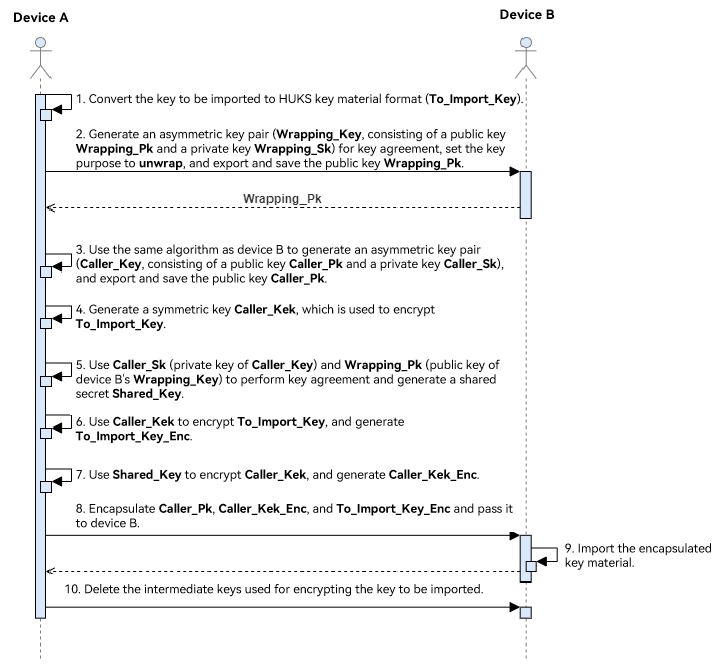
During the encrypted import process, the following HUKS capabilities are called in sequence:
- Generate an asymmetric key pair and export the public key for key agreement between devices.
- Generate a symmetric key to encrypt the key to be imported.
- Use the symmetric key to encrypt the key to be imported to generate the key ciphertext.
- Imports the encrypted key.
- Delete the intermediate keys used for encrypting the key to be imported.
The public key plaintext material returned by the key export API is encapsulated in X.509 format. The key material in the key import API must be encapsulated in the LengthData-Data format, for example, [(Lengthpart1Datapart1)... (LengthpartnDatapartn)].
NOTE
- The encrypted import supports key agreement algorithms ECDH and X25519. The generated Shared_Key uses the AES-GCM algorithm to encrypt Caller_Kek. For details about the cipher suites, see HuksUnwrapSuite.
- The mini-system devices support plaintext import but not encrypted import.
Key Material Format for Encrypted Import
| Content | Length |
|---|---|
| Service public key Caller_Pk length (LCaller_Pk) | 4 bytes |
| Service public key Caller_Pk | LCaller_Pk bytes |
| Shared_Key AAD2 length (LAAD2) | 4 bytes |
| Shared_Key AAD2 | LAAD2 bytes |
| Shared_Key Nonce2 length (LNonce2) | 4 bytes |
| Shared_Key Nonce2 | LNonce2 bytes |
| Shared_Key AEAD2 length (LAEAD2) | 4 bytes |
| Shared_Key AEAD2 | LAEAD2 bytes |
| Caller_Kek_enc length (LCaller_Kek_enc) | 4 bytes |
| Caller_Kek ciphertext Caller_Kek_enc | LCaller_Kek_enc bytes |
| Caller_Kek AAD3 length (LAAD3) | 4 bytes |
| Caller_Kek AAD3 | LAAD3 bytes |
| Caller_Kek Nonce3 length (LNonce3) | 4 bytes |
| Caller_Kek Nonce3 | LNonce3 bytes |
| Caller_Kek AEAD3 length (LAEAD3) | 4 bytes |
| Caller_Kek AEAD3 | LAEAD3 bytes |
| To_Import_Key_size length (LTo_Import_Key_size) | 4 bytes |
| Key plaintext material length To_Import_Key_size | LTo_Import_Key_size bytes |
| To_Import_Key_enc length (LTo_Import_Key_enc) | 4 bytes |
| To_Import_Key ciphertext To_Import_Key_enc | LTo_Import_Key_enc bytes |
Supported Algorithms
The following table lists the supported key import specifications.
The key management service specifications include mandatory specifications and optional specifications. Mandatory specifications are algorithm specifications that must be supported. Optional specifications can be used based on actual situation. Before using the optional specifications, refer to the documents provided by the vendor to ensure that the specifications are supported.
You are advised to use mandatory specifications in your development for compatibility purposes.
Specifications for Standard-System Devices
| Algorithm | Supported Key Length (Bit) | API Version | Mandatory |
|---|---|---|---|
| AES | 128, 192, 256 | 8+ | Yes |
| RSA | 512, 768, 1024 | 8+ | No |
| RSA | 2048, 3072, 4096 | 8+ | Yes |
| RSA | An integer multiple of 8, ranging from 1024 to 2048 (inclusive) | 16+ | Yes |
| HMAC | An integer multiple of 8, ranging from 8 to 1024 (inclusive) | 8+ | Yes |
| ECC | 224 | 8+ | No |
| ECC | 256, 384, 521 | 8+ | Yes |
| ED25519 | 256 | 8+ | Yes |
| X25519 | 256 | 8+ | Yes |
| DSA | An integer multiple of 8, ranging from 512 to 1024 (inclusive) | 8+ | No |
| DH | 2048 | 8+ | Yes |
| DH | 3072, 4096 | 8+ | No |
| SM2 | 256 | 9+ | Yes |
| SM4 | 128 | 9+ | Yes |
| DES | 64 | 16+ | Yes |
| 3DES | 128, 192 | 16+ | Yes |
Specifications for Mimi-System Devices
Before implementing the specifications for mini-system devices, determine whether your device supports the related specifications.
| Algorithm | Supported Key Length (Bit) | API Version |
|---|---|---|
| AES | 128, 192, 256 | 12+ |
| DES | 64 | 12+ |
| 3DES | 128, 192 | 12+ |
| RSA | An integer multiple of 8, ranging from 1024 to 2048 (inclusive) | 12+ |
| HMAC | An integer multiple of 8, ranging from 8 to 1024 (inclusive) | 12+ |
| CMAC | 128 | 12+ |
Key Import Formats
HUKS supports various types of keys in different formats. The following table lists the key types and key material formats supported by HUKS.
| Key Type | Algorithm | Import Format |
|---|---|---|
| Symmetric key | - | Key in bytes |
| Asymmetric key pair | - | Key pair material format |
| Public key of an asymmetric key pair | Ed25519, X25519 | See Importing the X25519 Key and Public Key. |
| Public key of an asymmetric key pair | RSA, ECC, ECDH, DSA, DH, SM2 | DER format defined in X.509 |
你可能感兴趣的鸿蒙文章
harmony 鸿蒙Universal Keystore Kit (Key Management Service)
harmony 鸿蒙Specifying the User for Key Operations (for System Applications Only)
harmony 鸿蒙Checking a Key (ArkTS)
harmony 鸿蒙Checking a Key (C/C++)
harmony 鸿蒙Basic Concepts of HUKS
harmony 鸿蒙Deleting a Key (ArkTS)
harmony 鸿蒙Deleting a Key (C/C++)
harmony 鸿蒙Encryption and Decryption (ArkTS)
harmony 鸿蒙Encryption and Decryption (C/C++)
harmony 鸿蒙Encryption and Decryption Overview and Algorithm Specifications